
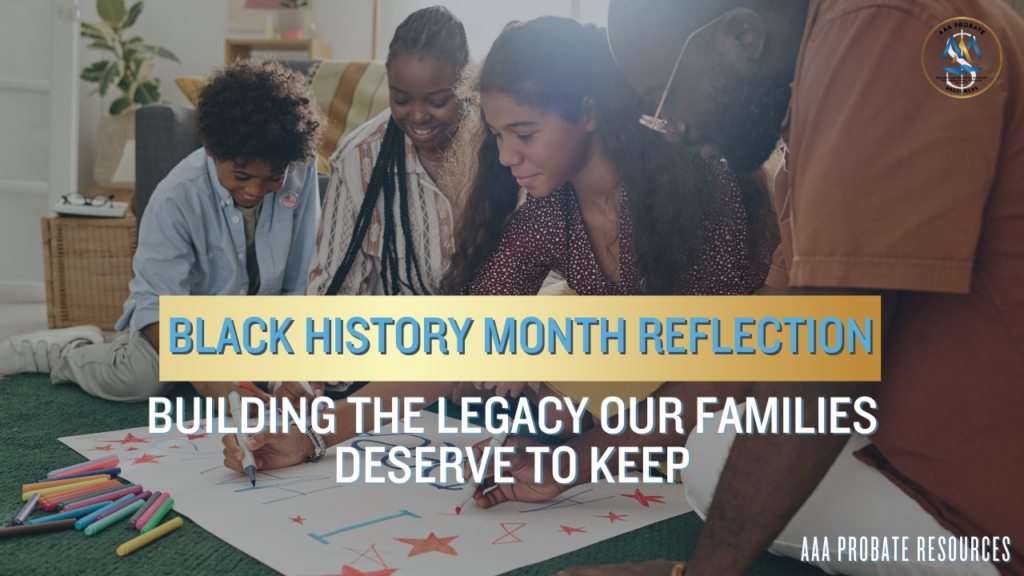
Every February, we celebrate what our ancestors built. But how often do we stop and ask: what are we doing to protect it?
Black History Month is a time of pride, reflection, and remembrance. We honor the trailblazers, the freedom fighters, the everyday people who refused to let this country erase them.
Some of that loss was the result of discrimination, violence, and systemic exclusion. But a significant portion happened through something far less visible: heirs’ property.
But there is a conversation we don’t have enough during this month. One about what happens after the celebration. About whether the wealth, land, and legacy our families worked so hard to build will still be there for the next generation.
The Wealth Gap Is Real and It Didn’t Happen by Accident
The median white family in America holds about 8 times the wealth of the median Black family. That number isn’t just a statistic. It is the result of centuries of exclusion, exploitation, and policies designed to keep Black families from building and keeping wealth.
Redlining. Discriminatory lending. Stolen land. Wage theft. Generation after generation, the rules were designed to take.
But here’s what those systems could never take away: the will to build anyway.
Our Ancestors Built More Than We Give Them Credit For
By 1910, Black Americans owned over 14 million acres of land. Black Wall Street in Tulsa, Oklahoma was home to over 300 Black owned businesses, hospitals, and schools. Black entrepreneurs, doctors, lawyers, and landowners built thriving communities from scratch, often with no legal protection and under constant threat.
They built anyway.
And then, in many cases, it was taken. Through racial violence, predatory laws, and a legal system that was never designed to protect them.
The 1921 Tulsa Race Massacre alone destroyed an estimated 35 blocks of one of the most prosperous Black communities in the country. Survivors received no reparations. Most never recovered financially.
The Missing Piece: Estate Planning
Here is the painful truth. Some of what was lost didn’t require outside forces to disappear. Some of it slipped away quietly, from the inside, because families never had the legal tools to hold it together.
No will. No trust. No plan.
When a loved one passes without a will, the courts decide what happens next. And the courts have not historically been kind to Black families.
Consider this. Only 24% of Black Americans have a will, compared to over half of white Americans. That gap means billions in assets, property, and savings that should be passing from one generation to the next are instead getting tied up in probate, divided among estranged relatives, or lost entirely.
Legacy Is a Verb
Honoring our ancestors isn’t just about knowing their names. It’s about finishing what they started.
Every elder who worked double shifts, every grandparent who paid off a house, every family member who sacrificed so the next generation could have more they were making a down payment on your future. The question is whether we are going to cash that check or let it expire.
Building legacy means taking action while you still can:
- Write a will and update it as your life changes
- Talk to your family about what you own and what you want to happen to it
- Learn about heirs property and whether your family is at risk
- Create an estate plan that reflects your values, not just your assets
- Start the conversation even when it feels uncomfortable
The most loving thing you can do for your family is plan.
This Black History Month, Honor Them by Protecting What’s Yours
We light candles for the past. But legacy is built in the present.
Building the legacy our families deserve to keep isn’t just a February conversation. It’s a lifelong commitment.
Want to Avoid the Drama Altogether?
If you’re feeling overwhelmed, don’t worry—we’re here to help. Book a free 20-minute call with Ashley to get personalized advice on your situation.
Let’s work together to create a plan that ensures your family’s future is secure and stress-free.
Stay Connected
For more tips on estate planning, follow us on Instagram where we regularly share valuable insights and resources.